
2025
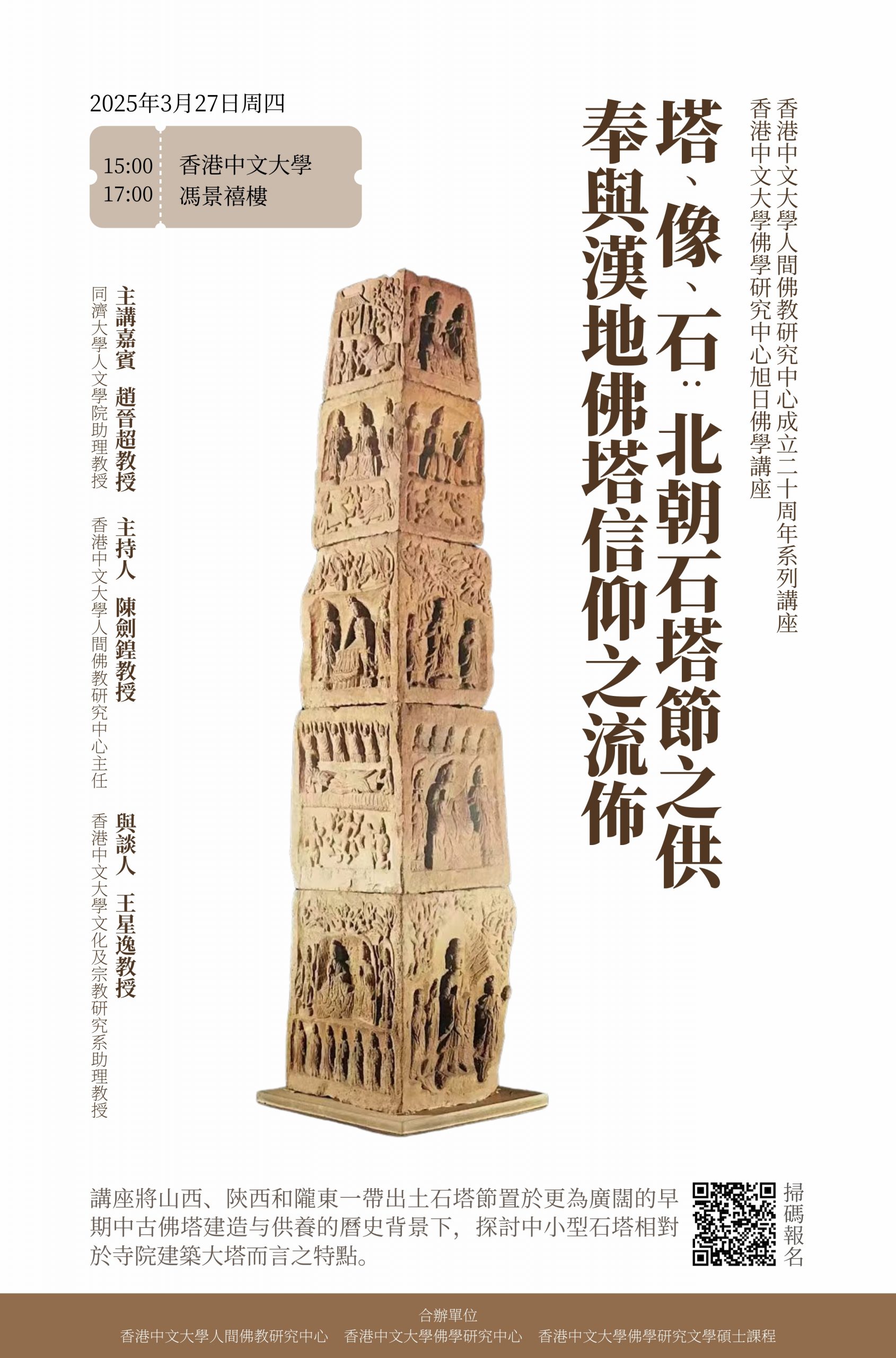
Topic:
Towers, Statues, Stones: The Worship of Stone Towers in the Northern Dynasties and the Distribution of Buddhist Tower Beliefs in Han China
Speaker:
Prof. ZHAO Jin Chao (Assistant Professor, Tongji University)
Date:
27 Mar 2025 (Thursday)
Time:
15:00 - 17:00
Format:
Onsite lecture
Venue:
Fung King Hey Building, The Chinese University of Hong Kong, Shatin, Hong Kong
Language:
Mandarin
Registration:
Lecture Introduction
This lecture will place the stone tower festivals unearthed in Shanxi, Shaanxi, and the eastern part of Gansu within a broader historical context of early medieval Buddhist tower construction and worship. It will explore the characteristics of small and medium-sized stone towers in relation to larger temple structures. The research will also combine stone towers with inscriptions, analyzing the similarities and differences among "towers," "statues," and "stones" from the perspective of donors in the Northern Dynasties.
Speaker Profile
Professor Zhao Jinchao holds a Ph.D. in Art History from the University of Virginia. He completed a joint postdoctoral fellowship at NYU Shanghai and Fudan University in Asian Studies. Currently, he is an Assistant Professor in the Department of Arts and Cultural Industries at the School of Humanities, Tongji University, and is recognized as a Pujiang Talent in Shanghai. Additionally, he is a visiting scholar at the Institute of Chinese Culture at the Chinese University of Hong Kong and the French Institute for Advanced Study.
His primary research focuses on medieval Chinese Buddhist art, early Indian Buddhist art, and 20th-century Chinese overseas school education in India. He has published numerous articles in both Chinese and English journals, as well as book chapters and academic translations.
Topic:
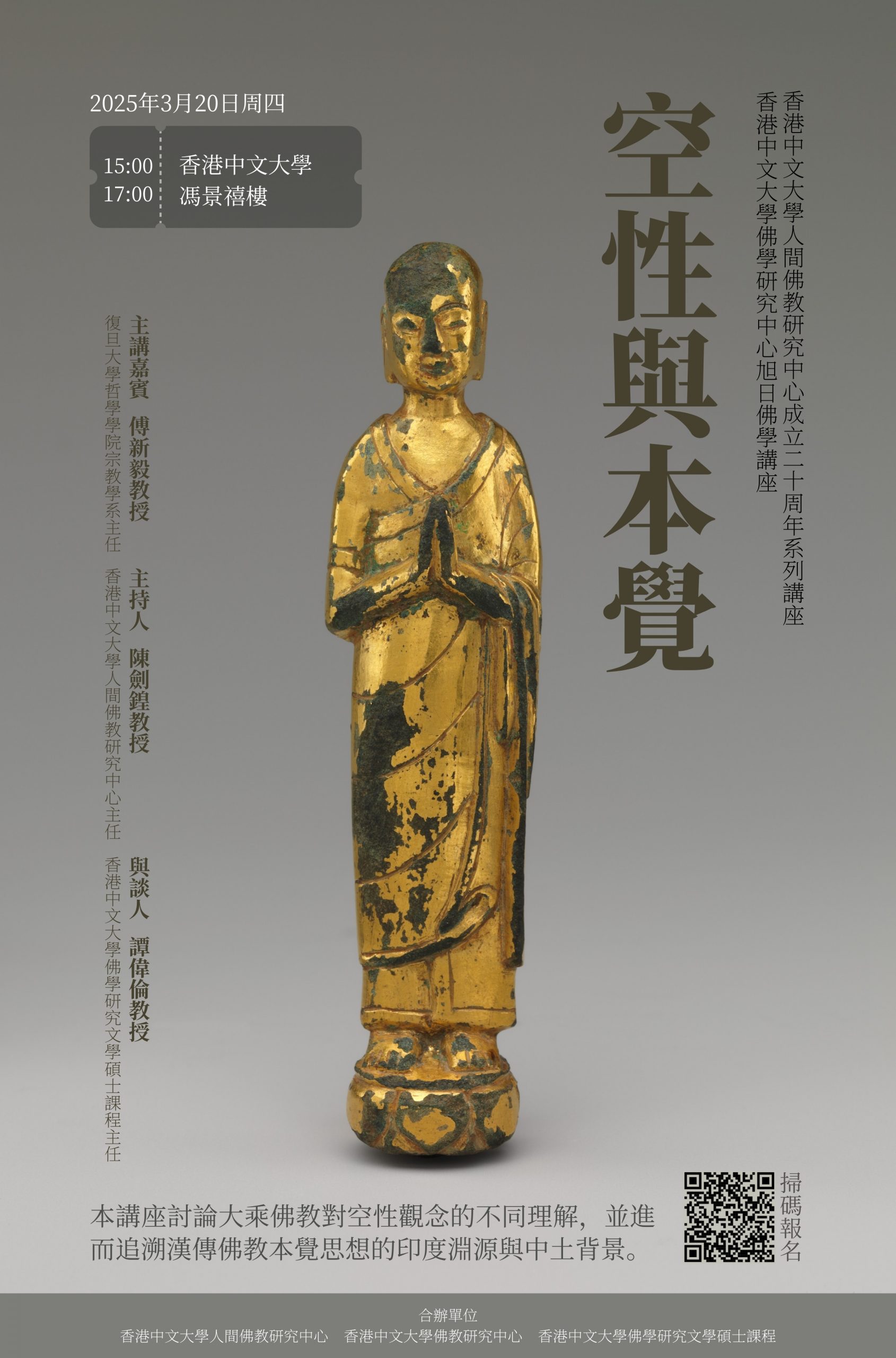
Emptiness and Original Awakening
Speaker:
Prof. Fu Xin Yi (The Director of the Department of Religious Studies at the School of Philosophy, Fudan University)
Date:
20 Mar 2025 (Thursday)
Time:
15:00 - 17:00
Format:
Onsite lecture
Venue:
Fung King Hey Building, The Chinese University of Hong Kong, Shatin, Hong Kong
Language:
Mandarin
Registration:
Lecture Introduction
This lecture discusses the different interpretations of the concept of emptiness in Mahayana Buddhism and traces the Indian origins and Chinese context of the notion of Original Awakening in Chinese Buddhism.
Speaker Profile
Professor Fu Xinyi, Ph.D., is currently a professor at the School of Philosophy at Fudan University, serving as a doctoral supervisor, the director of the Department of Religious Studies, and the head of the Institute of Religious Studies. He is also a member of the editorial board and associate editor of the "Continuation of the Chinese Tripitaka (Han Literature Part)," as well as the associate editor of "Buddhist Cultural Studies." Additionally, he is a doctoral and master's supervisor at institutions such as the China Buddhist Academy and Minnan Buddhist Academy. His main research areas include Buddhist philosophy and Buddhist literature, with a particular focus on the study of Yogācāra, Abhidharma, and Pramana (logic).
Topic:
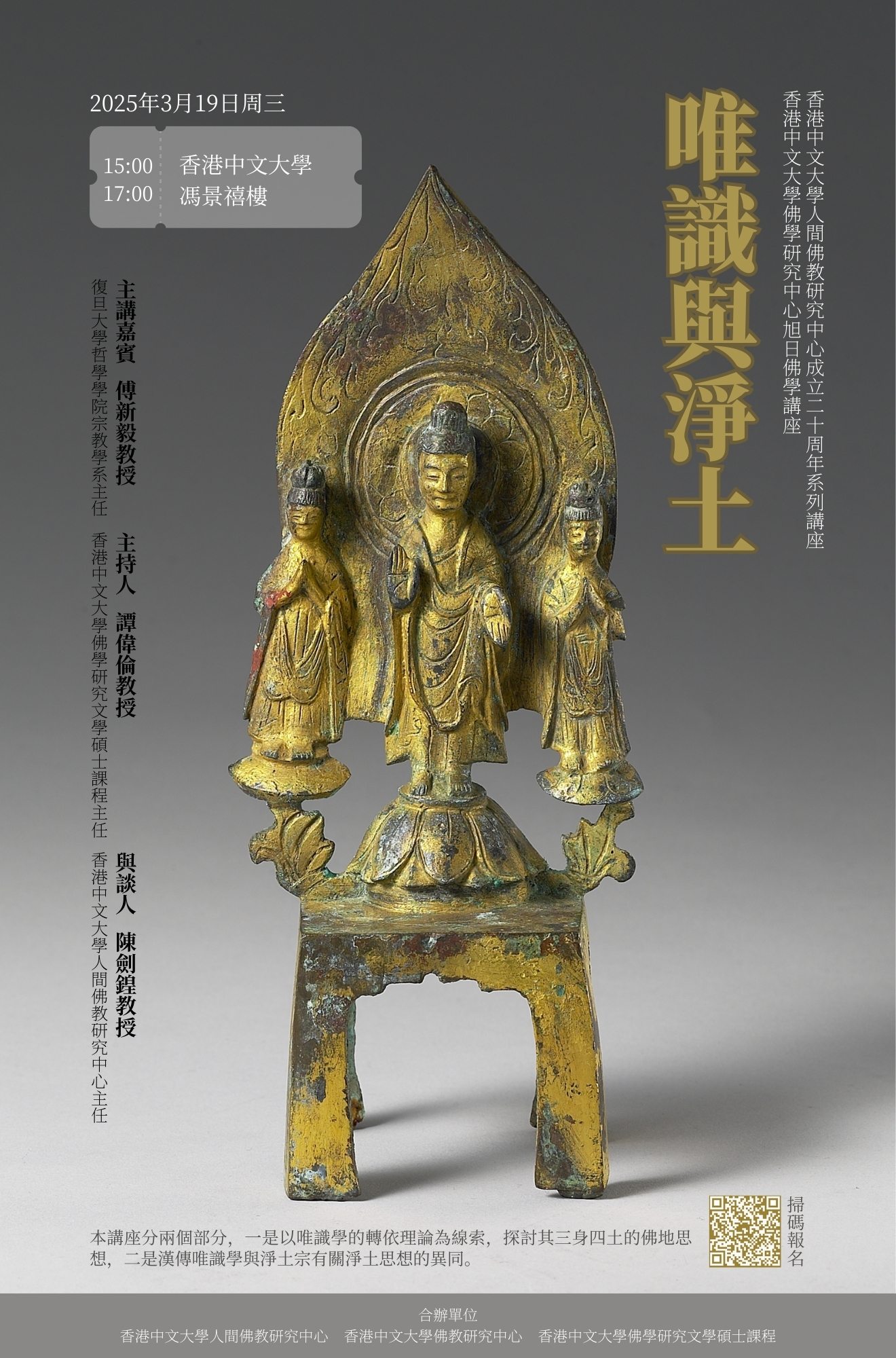
Yogācāra and Pure Land
Speaker:
Prof. Fu Xin Yi (The Director of the Department of Religious Studies at the School of Philosophy, Fudan University)
Date:
19 Mar 2025 (Wednesday)
Time:
15:00 - 17:00
Format:
Onsite lecture
Venue:
Fung King Hey Building, The Chinese University of Hong Kong, Shatin, Hong Kong
Language:
Mandarin
Registration:
Lecture Introduction
This lecture is divided into two parts: The first part will explore the concept of the three bodies and four lands in Buddhist thought, using the theory of transformation in Yogācāra as a thread. The second part will examine the similarities and differences between the Pure Land thought in Chinese Yogācāra and Pure Land Buddhism.
Speaker Profile
Professor Fu Xinyi, Ph.D., is currently a professor at the School of Philosophy at Fudan University, serving as a doctoral supervisor, the director of the Department of Religious Studies, and the head of the Institute of Religious Studies. He is also a member of the editorial board and associate editor of the "Continuation of the Chinese Tripitaka (Han Literature Part)," as well as the associate editor of "Buddhist Cultural Studies." Additionally, he is a doctoral and master's supervisor at institutions such as the China Buddhist Academy and Minnan Buddhist Academy. His main research areas include Buddhist philosophy and Buddhist literature, with a particular focus on the study of Yogācāra, Abhidharma, and Pramana (logic).
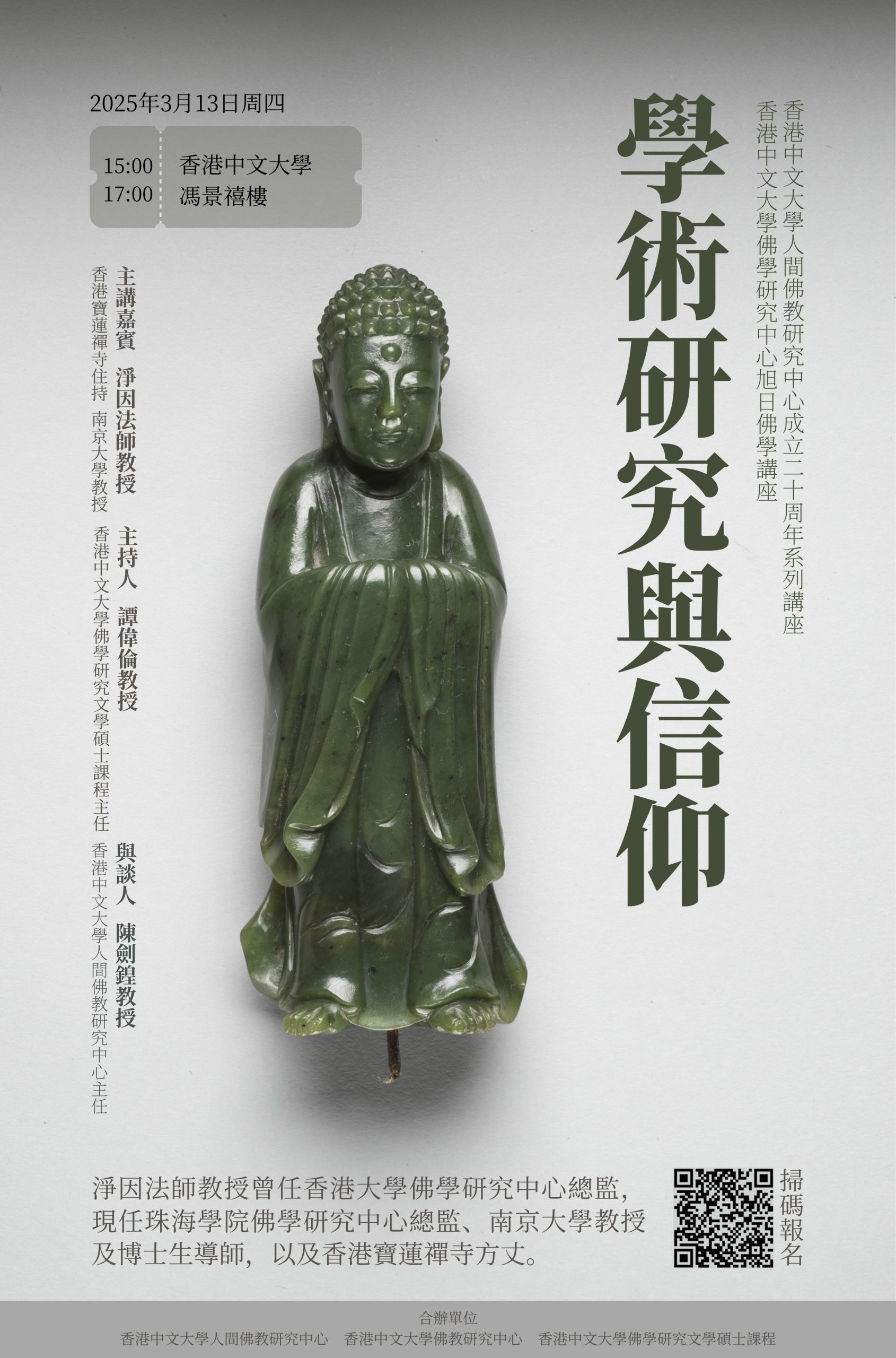
Topic:
Academic Research and Faith
Speaker:
Ven. Jing Yin (the Abbot of Po Lin Monastery/Professor, Nanjing University)
Date:
13 Mar 2025 (Thursday)
Time:
15:00 - 17:00
Format:
Onsite lecture
Venue:
Fung King Hey Building, The Chinese University of Hong Kong, Shatin, Hong Kong
Language:
Mandarin
Registration:
Lecture Introduction
In the realm of academia where rationality is paramount, faith is often seen as a non-scientific "other." Are the two necessarily in opposition? This lecture will delve into the complex interactions between academic research and systems of faith, analyzing the intertwining of rational inquiry and spiritual pursuit from multiple perspectives, including the philosophy of science and religious studies. Master Jingyin will share valuable research experiences, discussing how faith influences academic thinking and their mutual interactions. The master will also conduct an in-depth analysis of belief systems across different cultural contexts and explore their potential impacts on research methodologies and outcomes.
Speaker Profile
Venerable Jing Yin, currently serves as the Abbot of Po Lin Monastery, a professor and doctoral supervisor at Nanjing University, the Director of Centre of Buddhist Studies at Hong Kong Chu Hai College, a visiting professor at the University of Hong Kong, a member of the Board of Directors at Hong Kong Nang Yan College of Higher Education, and a subject expert for the Hong Kong Council for Accreditation of Academic and Vocational Qualifications. He has previously held the position of Director of the HKU Centre of Buddhist Studies.
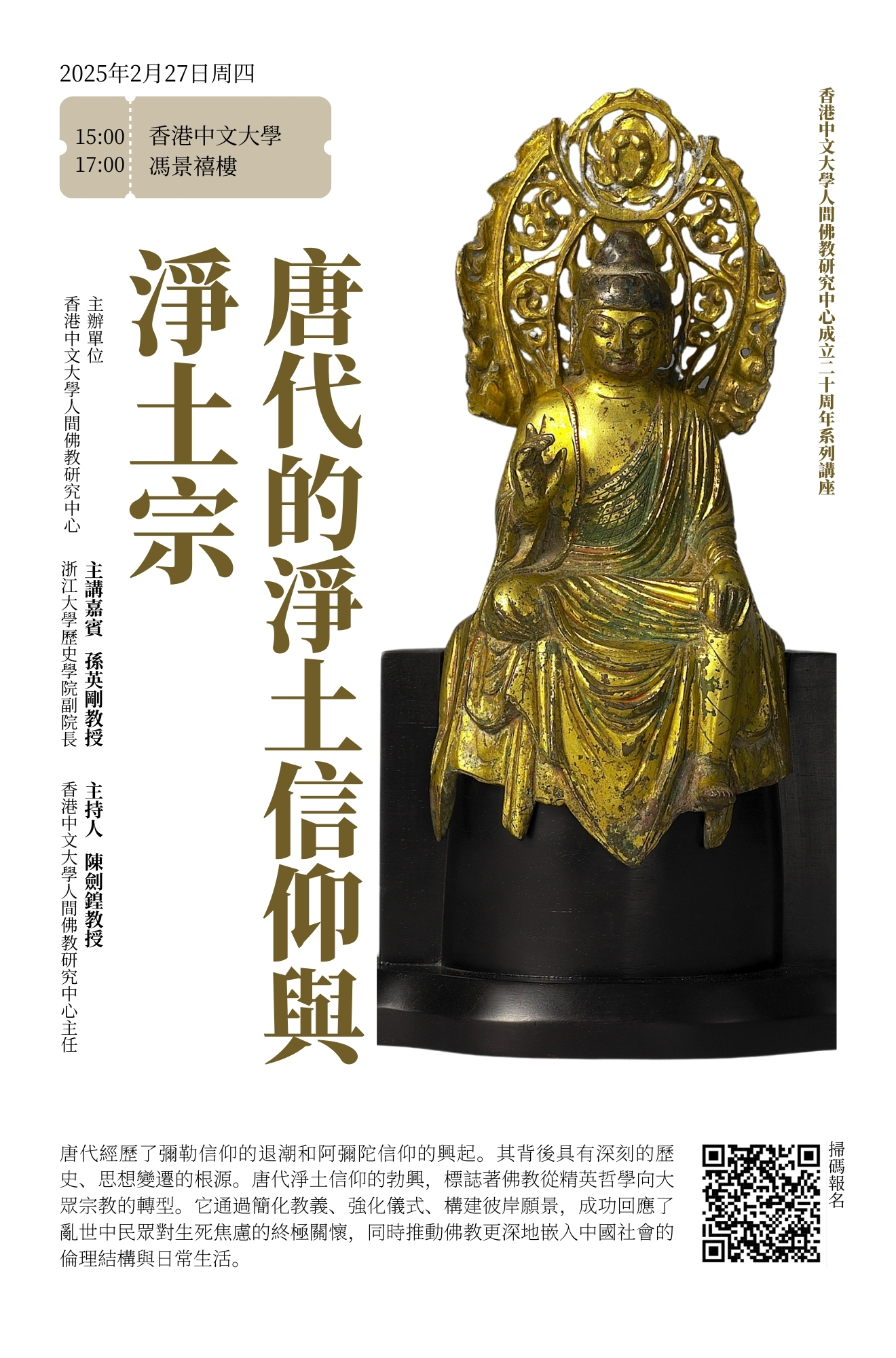
Topic:
Pure Land Belief and Pure Land Buddhism in the Tang Dynasty
Speaker:
Prof. Sun Ying Gang (Zhejiang University)
Date:
27 Feb 2025 (Thursday)
Time:
15:00 - 17:00
Format:
Onsite lecture
Venue:
Fung King Hey Building, The Chinese University of Hong Kong, Shatin, Hong Kong
Language:
Mandarin
Registration:
Lecture Introduction
During the Tang Dynasty, there was a decline in Maitreya belief and a rise in Amitabha belief, rooted in profound historical and ideological changes. The flourishing of Pure Land belief in the Tang era marked a transformation of Buddhism from an elite philosophy to a popular religion. By simplifying doctrines, strengthening rituals, and constructing visions of the Pure Land, it effectively addressed the ultimate concerns of the populace regarding life and death during a time of chaos. This movement also facilitated a deeper embedding of Buddhism within the ethical structure and daily life of Chinese society. Its legacy is reflected not only in religious practices but also in the profound influence it had on Chinese concepts of death, artistic aesthetics, and even social organization, making it a significant aspect of the history of Buddhist development in China.
Speaker Profile
Sun Yinggang, Ph.D. from Princeton University, is a professor and executive vice dean of the School of History at Zhejiang University. He is a recipient of the Ministry of Education's Young Changjiang Scholars Award and serves as the chief expert for a major project under the National Social Science Fund. Additionally, he is the vice president of the Chinese Society for the Study of the Wei, Jin, Southern and Northern Dynasties. His research focuses on the history of Buddhism, medieval history, and the Silk Road. He has published several works, including "The Era of Divine Texts," "A History of Gandharan Civilization," and "The History of the Sui, Tang, and Five Dynasties." He has authored over 100 academic papers published in journals such as "Historical Research," "Chinese Historical Research," and "World Religious Studies." He has been invited multiple times to conduct research and teach at academic institutions in Europe, America, Japan, and Taiwan.
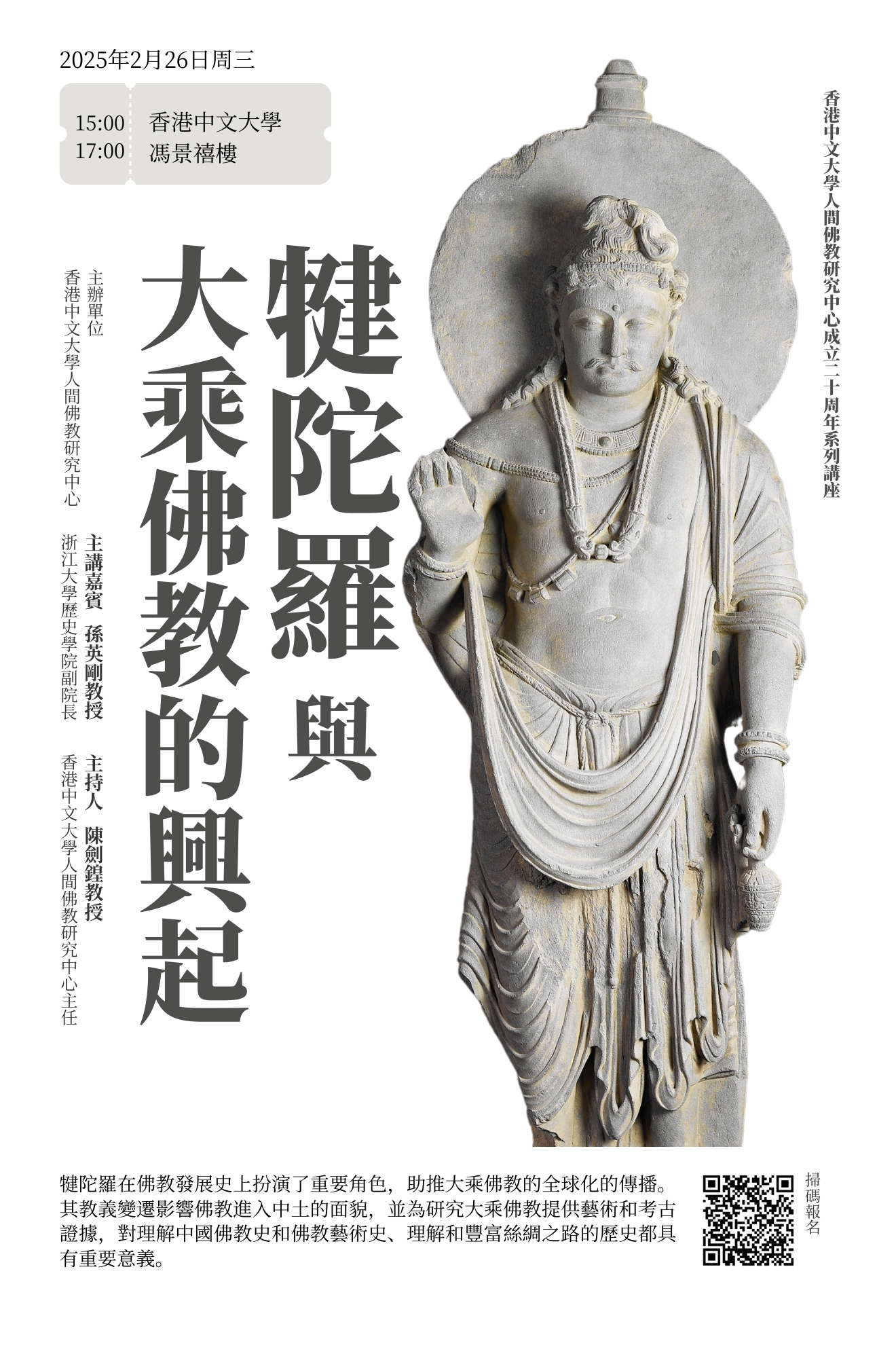
Topic:
The Rise of Gandhara and Mahayana Buddhism
Speaker:
Prof. Sun Ying Gang (Zhejiang University)
Date:
26 Feb 2025 (Wednesday)
Time:
15:00 - 17:00
Format:
Onsite lecture
Venue:
Fung King Hey Building, The Chinese University of Hong Kong, Shatin, Hong Kong
Language:
Mandarin
Registration:
Lecture Introduction
Gandhara played an important role in the history of Buddhist development. The rise of Mahayana Buddhism around the turn of the era marked a "globalization" movement in the spread of Buddhism across Asia. During this time, Buddhism underwent changes in doctrine and thought, including the flourishing of the bodhisattva belief, the rise of Pure Land faith, and the promotion of the spirit of generosity. These changes subsequently influenced the appearance of Buddhism once it entered the Central Plains. Many elements of Chinese Buddhist thought and artistic symbols can be traced back to Gandhara. Research on Gandharan Buddhism provides art historical and archaeological evidence for the study of the rise of Mahayana Buddhism, allowing visual corroboration of textual records and enriching the historical landscape of Buddhist development. This is of significant importance for understanding the history of Chinese Buddhism, the history of Buddhist art, and the history of the Silk Road.
Speaker Profile
Sun Yinggang, Ph.D. from Princeton University, is a professor and executive vice dean of the School of History at Zhejiang University. He is a recipient of the Ministry of Education's Young Changjiang Scholars Award and serves as the chief expert for a major project under the National Social Science Fund. Additionally, he is the vice president of the Chinese Society for the Study of the Wei, Jin, Southern and Northern Dynasties. His research focuses on the history of Buddhism, medieval history, and the Silk Road. He has published several works, including "The Era of Divine Texts," "A History of Gandharan Civilization," and "The History of the Sui, Tang, and Five Dynasties." He has authored over 100 academic papers published in journals such as "Historical Research," "Chinese Historical Research," and "World Religious Studies." He has been invited multiple times to conduct research and teach at academic institutions in Europe, America, Japan, and Taiwan.
